How to Set Kind Boundaries Guided by Biblical Wisdom
Table of Contents
Let Biblical wisdom shape what you say yes to with screens and sweets
Build kind boundaries that actually work in a busy family
Grace trains you, not shame, so you can reset after slips (Titus 2:11-12)
It's easy to promise yourself, "just ten minutes," then look up and it's late, you're still scrolling, and tomorrow feels heavier already.
Then there's the snack habit. A biscuit to keep the peace, a handful of sweets to stop the arguing, a treat for you because the day was a lot.
Meanwhile, your children push back hard when it's time to stop. The iPad goes off and the tears start. The sweet cupboard shuts and the protests rise. You end the day worn out, unsure if you're being too soft or too strict.
You don't need harsh rules to grow self-control with screens and sweets. You need kind boundaries that protect your home and your heart.
Three simple Scriptures can shape both your "yes" and your "no": Guard your heart (Proverbs 4:23), not everything is helpful (1 Corinthians 6:12), and grace trains you (Titus 2:11-12).
What follows is practical, realistic help you can start today.
Let Biblical wisdom shape what you say yes to with screens and sweets
Boundaries often sound like a battle plan, but Biblical boundaries are closer to a garden fence. A fence isn't there to punish the plants. It's there to protect what's growing.
Proverbs 4:23 says, "Above all else, guard your heart, for everything you do flows from it." That includes what you watch, what you reach for when you're stressed, and what your children learn to reach for too.
Screens and sweets are not "bad" by default. But they can become loud voices in your home if they're used as the solution.
And they can become idols that we run to instead of turning to Jesus for help.
Then you have 1 Corinthians 6:12: '"I have the right to do anything," you say, but not everything is beneficial. "I have the right to do anything," but I will not be mastered by anything.'
This moves the question from "Am I allowed?" to "Is this actually helping us?" It also gives you language for the feeling of being pulled along by habits you didn't choose on purpose.
Finally, Titus 2:11-12 reminds you that grace isn't just forgiveness. Grace also trains you to say "no" to what doesn't serve you, and "yes" to what builds a steady life.
Training suggests practice, not perfection. It suggests you can start small, repeat, and grow.
Guard your heart first, because behaviour follows (Proverbs 4:23)

Guarding your heart doesn't mean shutting out the world. It means paying attention to what gets easy access to you.
Your heart is like the control centre of your choices, reactions, and words. So, when your inputs are frantic, your outputs often follow suit.
In daily life, guarding your heart can look like noticing patterns. Maybe you scroll because you feel lonely at night. Maybe you snack because you're tired and a little sad, and food is quick comfort.
Perhaps you offer sweets because you want quiet and you're running on fumes. None of that makes you a bad mum. It makes you human.
Try a short self-check before you reach for the phone or the treats:
What am I really hungry for right now: rest, comfort, connection, or control?
What feeling am I trying to avoid: stress, boredom, or the fear of another meltdown?
What would help my body: water, a proper snack, a stretch, or an early night?
And as you get more practiced in doing this yourself, you can teach your children to check in with themselves to look for the underlying reason too. So they learn to deal with the root, and not the fruit.
"I am allowed", but is it helpful or mastering you? (1 Corinthians 6:12)
This verse doesn't shout "never enjoy anything." It asks a better question: "Is this beneficial, or is it beginning to own me?" Permission and wisdom are not the same thing.
You can be "allowed" to scroll, yet feel foggy and impatient afterwards.
Your child can be "allowed" a sweet, yet spiral into more begging and mood swings.
You can be "allowed" to use treats as a bribe, yet find it stops working, so you raise the reward.
That's the quiet slide into being mastered.
Here's a simple "helpful vs harmful" test you can use in the moment:
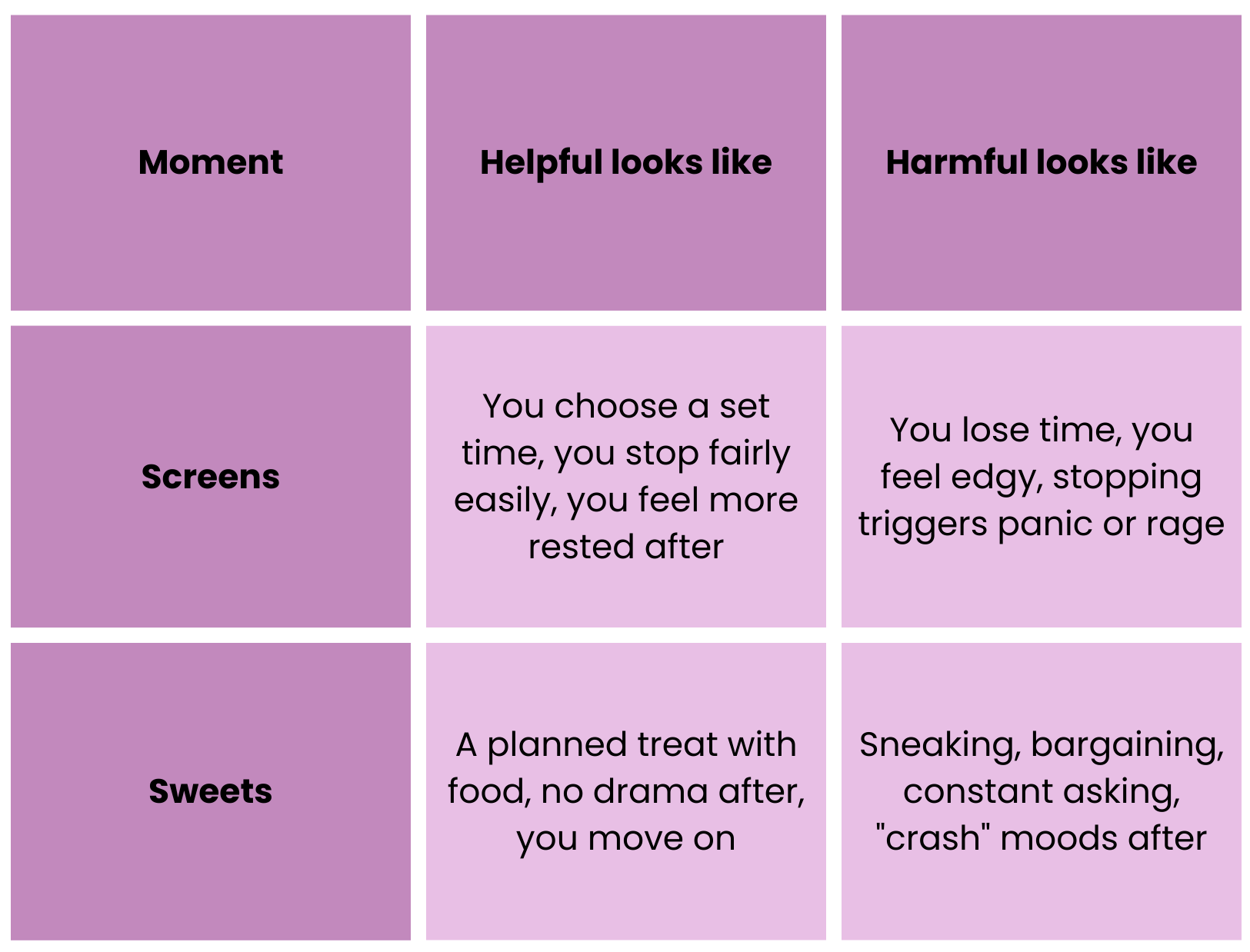
The takeaway is simple: if it's hard to stop, it's time to add support. That support can be a boundary, not a lecture.
Build kind boundaries that actually work in a busy family
A workable boundary feels steady, not complicated. It also feels warm, not sharp.
Your children don't need you to be perfect. They need you to be clear and consistent enough that they can relax and see that you've got it under control (even if they don't like your boundary).
Clear boundaries also reduce decision fatigue for you. When the rules change every day, you end up negotiating with tired brains (yours and theirs). Predictability helps everyone.
Think of boundaries as a rhythm. Breakfast, school run, dinner, bath, bed. Screens and sweets can sit inside that rhythm, rather than interrupting it.
Make your boundaries clear, simple, and easy to follow

If you've ever said, "Because I said so," and hated how it sounded, a simple structure can help. Use this boundary formula: When, Where, How much, and What happens next.
Keep it short enough to repeat without a speech.
Here are two examples that you can adjust to your family:
For screens:
When: after homework or dinner on weekends
Where: in the lounge, not bedrooms
How much: 30 minutes
What happens next: the tablet goes on charge in the kitchen, then you move to a different activity
For sweets:
When: with lunch, or after dinner on certain days
Where: at the table, not on the sofa or in the car
How much: one portion (you decide what that is)
What happens next: drink some water to remove the taste, then if you're still hungry have some fruit
Posting boundaries can remove some heat. Put friendly words on the fridge, so you're not "making it up" in the moment.
Keep it positive, like: "We enjoy screens after homework," or "Sweets are for after meals." That way you're children won't feel like you're controlling them. it's a house rule, not aimed specifically at them.
Use "yes first" parenting, then hold the line without guilt
Saying no is harder when your child hears "no" all day. So, start with what you can say yes to. Offer a path, not just a stop sign.
"Yes first" can sound like: "Yes, you can have something sweet, after lunch." Or, "Yes, you can have screen time, after your reading."
This doesn't remove disappointment, but it can help to make the boundary feel fair and give them a focus on when they can.
Here are three examples you can use and adjust. Keep your voice calm and your words brief.
Ending screen time:
"Time's up. I'm turning it off now."
"You can feel upset. Screens are finished."
"Next is a choice: Lego or a book with me."
Asking for sweets:
"You really want sweets. I hear you."
"Sweets are for after lunch."
"Right now you can choose fruit or cheese."
When you feel tempted yourself:
"I want to scroll because I'm tired."
"I'm going to set a 10-minute timer, then put my phone away."
"After that, I'll take 10 minutes to pray and share how I'm feeling with God."
You'll still feel the pull to give in, especially when you're worn down. In those moments, remind yourself what you're really offering yourself and your child: safety, not endless choice.
A kind boundary is loving, even when it's unpopular.

Grace trains you, not shame, so you can reset after slips (Titus 2:11-12)
Some days will go well. Others will go sideways by lunchtime. That's normal.
Self-control with screens and sweets grows through practice, not through promising yourself that you'll figure it all out when life calms down.
Titus 2:11-12 says grace teaches you how to live. Training is repeated reps. That means you can have a rough morning and still finish the day with wisdom.
It also means your children can learn gradually, with support rather than fear.
Shame says, "You've ruined it." Grace says, "Come back to what's true."
Shame makes you hide the biscuit packet or stay up later to numb out. Grace helps you name what happened and take one steady step.
Also, your children watch how you handle your own limits. When you practise small self-control, you give them a model they can trust.
You show them that boundaries aren't punishment, they provide safety.
And that will help them learn to understand why God has boundaries for us, especially regarding sin. It's not to ruin our fun, it's to keep us safe.
A simple reset plan for the next hour, not "I'll start again on Monday"
When you slip, aim small. You don't need a full life overhaul. You need a reset that fits the next hour.
Pause and breathe: Put both feet on the floor. Take three slow breaths.
Name the need: "I'm tired," "I'm stressed," or "I'm lonely."
Choose the next right thing: water, a proper snack, a short walk, or moving the charger to the kitchen.
Repair if needed: If you snapped, reconnect and restate the boundary.
Here's a quick repair script for when you shouted about the iPad: "I'm sorry I raised my voice. You didn't deserve that. The iPad is still finished, and I'm here with you while you're upset."
If you stress-ate biscuits and feel disappointed, keep it honest but kind: "I ate because I felt overwhelmed. I'm going to drink water and have a proper snack now."
Repair doesn't remove the limit. It restores trust.
When tantrums hit, respond with calm and a plan
Tantrums don't always mean your boundary was wrong. Often, they mean your child hit a limit and didn't know what to do with the feeling.
A calm plan helps you stay steady:
Validate: "You're frustrated because you want more."
Hold the boundary: "Screens are finished for today."
Offer a limited choice: "Do you want a cuddle, or space on the sofa?"
If meltdowns often follow screen limits or sweet limits, you'll want a few ready phrases, because your brain often goes blank under pressure.
Keep the free resource 5 Biblical Responses to Tantrums somewhere easy to find, so you can read it after the children are in bed, then practise one response the next day.
The goal isn't to stop all big feelings. It's to meet them with steady love and clear limits.
To sum up
Proverbs 4:23 calls you to guard your heart, because what you take in shapes what comes out.
1 Corinthians 6:12 gives you a wise filter: not everything is helpful, and you don't have to be mastered by scrolling or sugar.
Titus 2:11-12 brings relief, because grace trains you through small choices, repeated over time.
Start today with one boundary, for screens or sweets, or whatever needs a boundary in your children's lives. Write it down, keep it simple, and practise it for a week.
Adjust gently, but don't abandon it after one hard day.
Pray this to ask Jesus to help you each day: "Lord, help me guard my heart. Give me wisdom for what's helpful, and grace to practise again today. Teach me to lead my home with love and steadiness." Amen.