David Chose Not to Get Even: A Bible Lesson on Restraint
Table of Contents
What happened in 1 Samuel 24 and 26, and why David had a real reason to strike back
Why David stopped himself when revenge would have felt satisfying
Romans 12:17-21 shows the same lesson for your home today
How you can help your child practise restraint when someone is mean
When your own patience is thin, what David's example can teach you too
When someone is rude to your child, your heart can flare up in seconds.
When your child wants to hit back with words, attitude, or spite, you feel the pull too.
Getting even feels good in the moment, but it leaves a mess behind it.
That is why David's restraint matters so much.
In 1 Samuel 24 and 1 Samuel 26, David had a real chance to hurt Saul, the man who was hunting him and trying to kill him.
He did not pretend the wrong was small; he just chose not to take revenge.
Romans 12:17-21 teaches the same pattern for your home: God helps you choose peace instead of payback.
Before you teach this lesson to your children, it helps to see how hard David's choice really was.
What happened in 1 Samuel 24 and 26, and why David had a real reason to strike back
Saul kept hurting David, even when David had done nothing wrong
David was not dealing with a playground squabble. Saul was jealous of him, suspicious of him, and bent on stopping him.
David had served Saul well, yet Saul treated him like an enemy.
That matters, because children need to see this clearly.
David was not being dramatic. He was being mistreated.
Saul chased him through the wilderness and tried to kill him, even though David had stayed loyal.
If your child says, "But it wasn't fair", this story meets them there.
David knew what unfair felt like. He knew what it was to be targeted, misunderstood, and pressured.
Restraint is harder when you've done nothing to deserve the hurt. That is one reason David's example is so strong.
David had the chance to take revenge, but he chose self-control
In 1 Samuel 24, Saul went into a cave where David and his men were hiding.
David's men thought this was the perfect chance. One quick move, and the problem would be gone.
David only cut off a corner of Saul's robe, then felt troubled even for that.
Later, in 1 Samuel 26, David found Saul asleep in the camp. Saul's spear was beside him.
Abishai offered to pin Saul to the ground with one strike. Again, revenge was within reach. Again, David said no.
He took the spear and water jug instead, then left. David proved he could have hurt Saul yet again, but chose not to.
That is the lesson your child needs. Self-control is not weakness. Sometimes it is even stronger than fighting back.
Why David stopped himself when revenge would have felt satisfying
David trusted God to judge fairly
David did not say Saul's actions were fine. He did not shrug and call it nothing.
He believed God saw the wrong and would deal with it in the right way, at the right time.
That kind of trust is hard for adults, let alone children.
When your child is mocked, left out, or blamed for something they did not do, their first thought is often, "I need to fix this now."
David shows another way. You do not have to take God's place to be safe in God's care.
He refused to grab control with sinful hands. He left judgement where it belonged.
You don't have to call wrong right. You do have to choose what kind of heart you will have when wrong is done to you.
He chose mercy over payback, even with his enemy
Mercy sounds soft until you need it. Then you see how much courage it takes.
David spared the man who wanted him dead. That was not because David was scared. It was because David feared God more than he followed his feelings.
Your child feels this same pull in a smaller way.
Someone snatches a toy, rolls their eyes, whispers something cruel, or laughs when they fail.
Payback feels sweet for a second. Mercy feels costly.
But mercy is stronger than revenge, because it says, "I will not let your sin choose my behaviour."
That takes patience. It takes faith. It takes help from God.
David's choice was not natural. It was obedient.
That is good news for your home, because obedience can be taught and practised.
Romans 12:17-21 shows the same lesson for your home today
Paul says in Romans 12 that you are not to repay evil for evil.
He says to live at peace, as far as it depends on you, and to leave room for God's justice.
Then he says not to be overcome by evil, but to overcome evil with good. That is David's story in New Testament words.
Do not repay evil with evil
This is plain, but not easy.
If a child is mean at school, your child may want to be mean back.
If a sibling says something nasty, the next insult is often already loaded and ready.
Romans 12 tells you to break that pattern.
Not because the hurt is unreal, but because answering sin with sin never heals anything. It only multiplies the damage.
At home, that may mean stopping the cycle early.
"She shouted at me" is not permission to shout back.
"He started it" is not a Bible reason.
Your child can learn that wrong behaviour from someone else does not excuse wrong behaviour from them.
Leave room for God to deal with wrong in His way
This does not mean doing nothing. It does mean refusing revenge.
You can still name the wrong, speak to a teacher, set a boundary, or correct a child.
What you leave behind is the urge to wound back.
That is a relief, if you think about it. You are not asked to carry the full weight of justice on your own shoulders.
God sees. God knows. God is not late.
When your child asks, "But what if they get away with it?" you can say, "No one gets past God."
Choose the kind of response that helps peace grow
Peace does not always mean instant friendship.
It often starts with one calmer choice.
A gentle answer. Walking away. Asking an adult for help. Praying before speaking. Refusing the second hit, the second shove, the second cruel sentence.
That is how peace grows in a family too. You lower the temperature. You use fewer sharp words. You teach your child that strength can look like stopping.
Paul's words are not airy ideas for framed wall art. They are for kitchens, school runs, bedtime rows, and all the moments when tempers rise fast.
How you can help your child practise restraint when someone is mean
Children do not learn restraint by accident. They learn it in real moments, with your help, one small choice at a time.
Teach your child a simple pause-and-pray habit
When emotions are hot, long speeches do not work. Your child needs something short enough to remember.
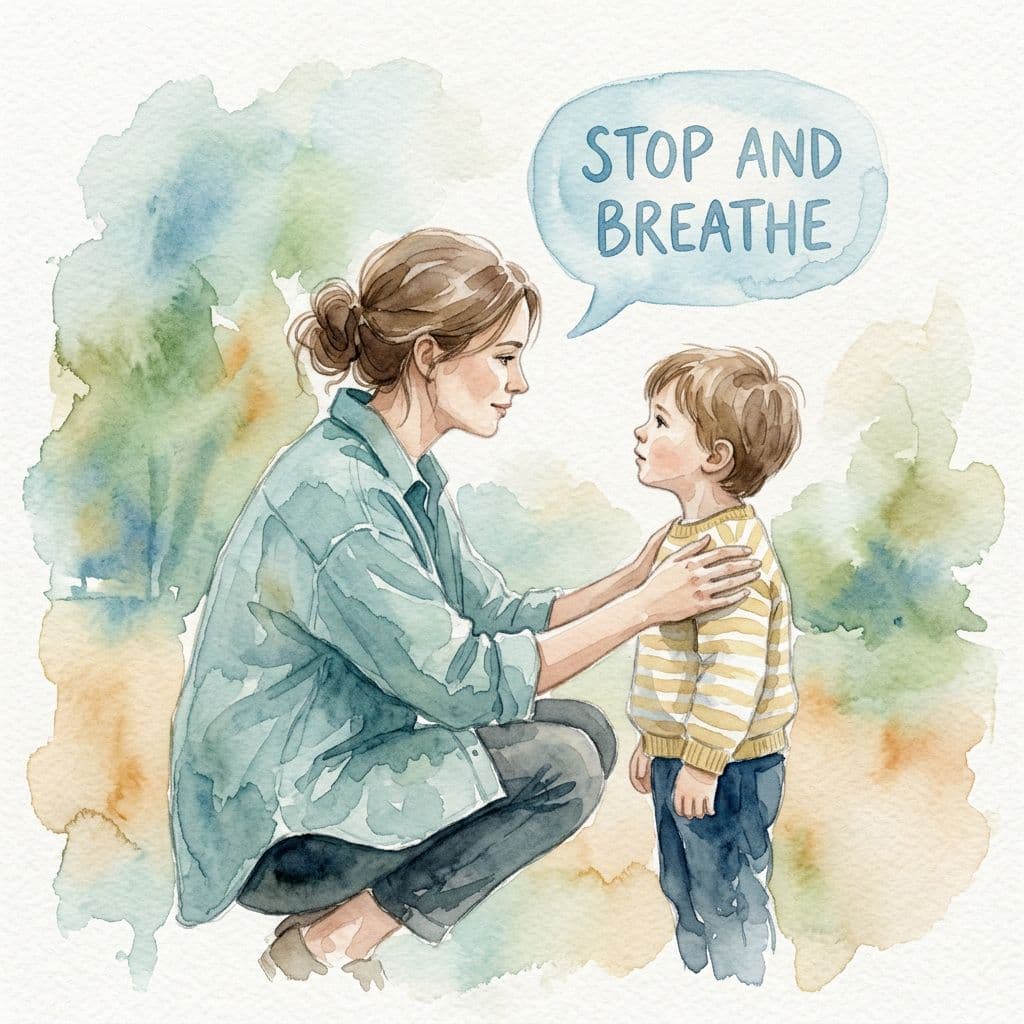
Try: stop, breathe, pray.
You can teach a tiny prayer like, "Jesus, help me choose peace."
Say it at calm times first. Practise it in the car, during bedtime, or after a small disagreement with a sibling.
Then it is more likely to come back when the real test arrives.
This habit gives your child a gap between feeling and reaction. That little gap matters.
Give your child words for brave, calm responses
Some children lash out because they do not know what else to say.
If you want restraint, give them words they can borrow until they are steady enough to find their own.
A few simple phrases can help:
"Please stop. I don't like that."
"I'm walking away now."
"I'm going to tell an adult."
"You may not speak to me like that."
These are not weak words. They are clear words. They let your child be firm without turning cruel.
You can role-play this at home. Keep it light. Let your child hear the words out loud.
Children often need a sentence ready before they can use it in the moment.
Praise self-control, not just perfect behaviour
If you only notice the moments your child gets it fully right, they may miss the progress.
Restraint often starts small. They almost shouted, but lowered their voice. They stomped off instead of hitting. They told you the truth about wanting revenge.
Praise that. Name it.
"You were angry, and you still stopped."
"You wanted to be nasty back, but you chose better words."
"That was hard, and you showed self-control."
This does two things. First, it helps your child see restraint as something real and learnable.
Second, it keeps the focus on heart growth, not image management.
You are not raising a child who never feels anger. You are raising a child who learns what to do with it.
When your own patience is thin, what David's example can teach you too
You may read David's story and think first about your children. Fair enough.
But there is a word here for you as well, especially on the days when you are tired, touched out, and one sibling squabble away from snapping.
Restraint is not the same as pretending it did not hurt
You do not have to smile through unkindness. You do not have to act as though harsh words did not sting.
David named the wrong. He simply refused revenge.
That matters in motherhood.
Self-control does not mean stuffing everything down until it leaks out sideways. It means you tell the truth without exploding.
You can say, "That was unkind", without adding a cutting line of your own.
You can be firm without being cruel
A peaceful home is not a home with no boundaries. It is a home where correction does not turn nasty.
You can be calm and clear at the same time.
You can step in, stop the behaviour, and set consequences.
You can protect one child from another child's unkindness.
You can address disrespect. None of that clashes with grace.
David did not confuse gentleness with weakness, and you do not have to either.
Firmness with prayer is still firmness. Boundaries with kindness are still boundaries.
The brave choice is not always the loud one
When someone is mean, revenge feels quick and satisfying.
David shows you a better way. He had reason to strike back, power to do it, and people telling him to take the chance. He still chose restraint.
That is the lesson you can carry into your home this week. With God's help, your child can learn not to repay wrong for wrong. So can you.
Pick one calm response and practise it before the next hard moment comes. Peace-making is not weak. It is brave, and trusting God is better than getting even.
And if you are in the depths of tantrum land, grab my free 5 Biblical Responses to Tantrums for some ways to diffuse the situation.